Born at Savaria in Pannonia (modern Szombathely, Hungary) to a pagan military tribune, Martin was raised at Pavia in Italy. Against his father’s wishes he became a catechumen at about age ten. Under the compulsory service laws for sons of veterans he was enrolled in the Roman cavalry as a youth and served in Gaul.
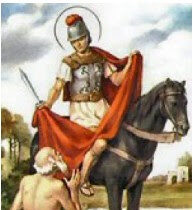
While stationed at Amiens on a bitter winter day, still a catechumen, he encountered a nearly naked beggar. With his sword he divided his military cloak and gave half to the man. That night he received a vision of Christ wearing the half-cloak and saying to the angels, “Martin, though only a catechumen, has clothed me.” He was baptized soon afterward. Later, before a campaign under the future emperor Julian, he sought discharge, declaring, “I am a soldier of Christ; I am not permitted to fight.” Accused of cowardice, he offered to stand unarmed before the enemy lines armed only with the sign of the cross. He was briefly imprisoned and then released.
After leaving the army he attached himself to Hilary of Poitiers. During Hilary’s exile he spent time in Italy and on the island of Gallinaria. Upon Hilary’s return (c. 360–361) Martin settled at Ligugé near Poitiers and established a community of hermits—the first monastery in Gaul. In 371 the people of Tours, by a ruse, brought him to the city and acclaimed him bishop over the objections of some of the clergy who found him too austere and unkempt. He accepted the office reluctantly and continued to live as a monk. Outside Tours he founded the monastery of Marmoutier, which grew into a major center of ascetic life and clerical formation. He died at Candes on 8 November 397 and was buried at Tours on 11 November.
As bishop he combined rigorous personal asceticism with active pastoral and missionary work. Sulpicius Severus, his contemporary biographer, records numerous healings, exorcisms, and at least two raisings of the dead. Martin systematically evangelized the countryside of Gaul, destroying pagan temples, altars, and sacred trees while establishing churches and small monastic houses on their sites. He opposed Arianism and, notably, interceded with the imperial authorities against the execution of the heretic Priscillian, holding that the Church should not shed blood over doctrinal error. Throughout his episcopate he retained the habits of a monk: poverty, manual labor, and withdrawal to Marmoutier whenever possible.
He was among the first non-martyrs to be venerated as a saint by popular acclamation. His shrine at Tours became a major pilgrimage center. The Western Church keeps his feast on 11 November (Martinmas); the Eastern Church on 12 November. He is traditionally patron of France, of soldiers, of beggars, of military chaplains, and of tailors. He was, in short, a Roman cavalryman who became a monk-bishop, a destroyer of pagan shrines, a founder of Western monastic life in Gaul, and a model of episcopal humility whose cult shaped the religious imagination of medieval Europe.