
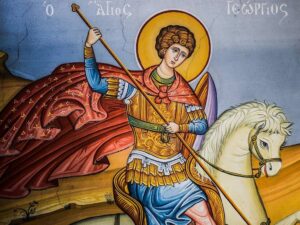
 Tradition holds that he was born circa 270–280 in Cappadocia (central Asia Minor, modern Turkey) to a Christian family of some standing. He entered Roman military service and rose to the rank of tribune (or a comparable officer’s grade), possibly serving in the imperial guard. When Emperor Diocletian’s persecution of Christians began in earnest around 303, George publicly refused to offer sacrifice to the pagan gods or to renounce the faith. He is said to have torn down or denounced the imperial edict. Arrested, he endured prolonged torture—accounts vary widely and grow more elaborate in later hagiography—yet remained steadfast. He was finally beheaded, most commonly placed at Lydda or Nicomedia, on or about 23 April 303 (or 304). His body was returned to Lydda, where a church was soon built over his relics and where his cult took root early.
Veneration spread rapidly in both East and West. He is ranked among the Great Martyrs in the Eastern churches and as one of the Fourteen Holy Helpers in the West. The famous dragon-slaying legend—George rescuing a princess and converting a city after killing a dragon—appears much later (first visual evidence in Cappadocia in the eleventh century; popularized in the West by Jacobus de Voragine’s Golden Legend in the thirteenth). It is best understood as an allegorical depiction of the triumph of Christ and the Church over evil, paganism, or the devil rather than a literal historical episode.
His cult reached England by the eighth century at latest (mentioned by Bede and others; churches dedicated before the Norman Conquest). The Crusades greatly intensified devotion: English and Norman knights encountered his Eastern cult, and visions of him were reported aiding Christian forces (notably at Antioch in 1098). King Richard I is associated with particular reverence for him during the Third Crusade.
Edward III, in 1348, founded the Order of the Garter under the patronage of Saint George and effectively established him as England’s national patron saint. The red cross of Saint George on a white field became the national flag of England and remains a principal element of the Union Flag. His feast (23 April) was elevated in status, and the battle-cry “God for Harry, England, and Saint George!” entered the national imagination through Shakespeare and later tradition.
Saint George is among the most widely adopted patrons in Christendom. He is the traditional protector of soldiers, cavalry, archers, scouts (Boy Scouts), farmers, and those afflicted with certain skin diseases. The principal nations, regions, and cities that claim him as patron saint are England, Portugal, Georgia, Bulgaria, Lithuania, Ethiopia, Moscow, Genoa, Venice, and Barcelona.