

 On Friay, October 2nd, Life Network is hosting their annual Gala. We are sponsoring a table and have room for 10 people. If you would like to attend this fundraiser, please contact the office.
The Gala will be held at The Double Tree Hotel, located at 1775 Cheyenne Mountain Blvd.
Silent Auction will begin at 5PM.
The Dinner and Program will begin at 6:30PM.

Annual Fall City Serve, October 3rd
Please join St. George’s Anglican Church as we partner with COS I Love You for their annual Fall City Serve day. This is a great opportunity to give your time and hard work to show Christ’s love through participating in a project.
Different projects include school clean up, yard work, or supporting our local heroes/first responders with gift bags and letter writing.
Please email stgacfamilies@gmail.com if you are interested in participating. We will share options and coordinate groups from STGAC.
Resource of the Week:
Book Review –
The “Right to Die” Will Be The Death of Solidarity, by Audrey Pollnow, at First Things

“Unfortunately, coercion into unwanted assisted death is only one of the ways in which terminally ill people are harmed by assisted death. The moment assisted death is offered, terminally ill people are exposed to two additional forms of harm.
First, they are made morally responsible for what they are “doing” to their loved ones by staying alive. If assisted death is a legitimate moral choice, suffering people can be morally guilty (even if not legally culpable) for refusing to end things when it is “reasonable” to do so.
Imagine a mother who is terminally ill. When assisted death is off the table, she and her loved ones are in the same boat, undergoing a difficult situation together. But when assisted death is offered, she gains the ability to dock the boat and let everyone off. She becomes responsible for everything her family is undergoing related to her illness. She ceases to be the victim of a tragedy and becomes the perpetrator of every aspect of it other than her death. Thus, one of the harms of legalizing assisted death is the moral burden it imposes on each terminally ill person, the burden of responsibility for what she is “doing” to her loved ones when she decides not to end her life.
The next harm is downstream of this moral responsibility: Other people simply will not feel the same sense of obligation toward a person who is dying slowly when he has the option to die quickly. As a result, many terminally ill people will be neglected in ways they wouldn’t be otherwise.”
Callistratus of Byzantium, Soldier and Martyr, d.304 A.D.
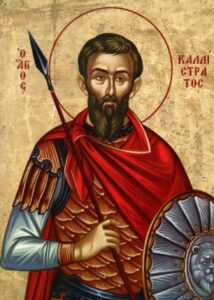
Life Callistratus was born in the mid-third century to Christian parents. An ancestor—named Neochorus or Okorus—had served as a soldier in Palestine under Pontius Pilate in the days of Tiberius, witnessed the Passion, death, and Resurrection of our Lord, and was converted. That faith was handed down in the family. Raised in piety, the young man entered the Roman army, serving in the Chalcedonian cohort. He was, for a time, the sole Christian in his unit. By night he rose to pray; by day he quietly catechized those of his comrades who would listen. His conduct was marked by gentleness and discipline, yet his secret devotion was overheard.
Ministry & Martyrdom
His ministry was that of a soldier-confessor and catechist. When reported to the commander (Persentinus or Presentinus), he refused to sacrifice to the idols, citing the Lord’s warning that whoever denies Him before men will be denied before the Father. The commander first had him beaten, dragged over sharp stones or potsherds, and subjected to other cruelties. He was then sewn into a linen sack and thrown into the sea. The sack struck a rock and tore; he swam unharmed to shore. The sight converted the forty-nine, who were all subsequently imprisoned with Callistratus. In prison he instructed them in the Faith, answered their questions, and prepared them for baptism and death. When they were bound and cast into a reservoir or lake, he prayed that the water might serve as their baptismal font; their bonds were loosed, they emerged as though already clothed in white, heavenly crowns appeared, a voice from heaven encouraged them, an earthquake toppled a nearby idol, and a further company of soldiers believed. Thus he offered to Christ what the hymns call “a noble army of athletes.”
Further floggings followed. Fearing mutiny, the commander finally sent soldiers into the prison by night; Callistratus and his forty-nine companions were cut to pieces or beheaded with the sword, most commonly dated to 27 September 304 in the Great Persecution under Diocletian. The surviving converts secretly buried the relics; a church was later raised on the site, as the martyr himself had foretold.
Legacy
The Church commemorates him and his companions on 27 September in the Byzantine calendar (26 September in the Roman Martyrology). He is numbered among the early warrior-saints whose cult took root while the Empire still persecuted the Faith. Relics were venerated in Constantinople; a monastery bore his name; hymns (troparion in Tone 3, kontakion in Tone 4) praise him for casting down the enemy and offering his converted comrades as incense to Christ. Icons and frescoes of the company appear in churches of the East. His shrine was credited with healings. For an officer who is also a clergyman, he stands as a double pattern: the soldier who will not deny his Lord even when the command comes from his own chain of command, and the pastor who, even in bonds, gathers a flock from among his own unit and leads them through water and sword into the Kingdom.
His example of steadfastness under arms and his pastoral labor among fellow soldiers are examples to all faithful followers of Christ, military and civilian alike.
September Pantry Needs for Mercy’s Gate

PRIORITY NEEDS
- Toilet paper
- Peanut butter
- Tuna
- Canned fruit
- Jelly
- Ramen
- Canned vegetables
- Pasta (not spaghetti)
- Spaghetti Sauce
- Cereal
- Oatmeal
- Canned Beans
- Canned Chicken