

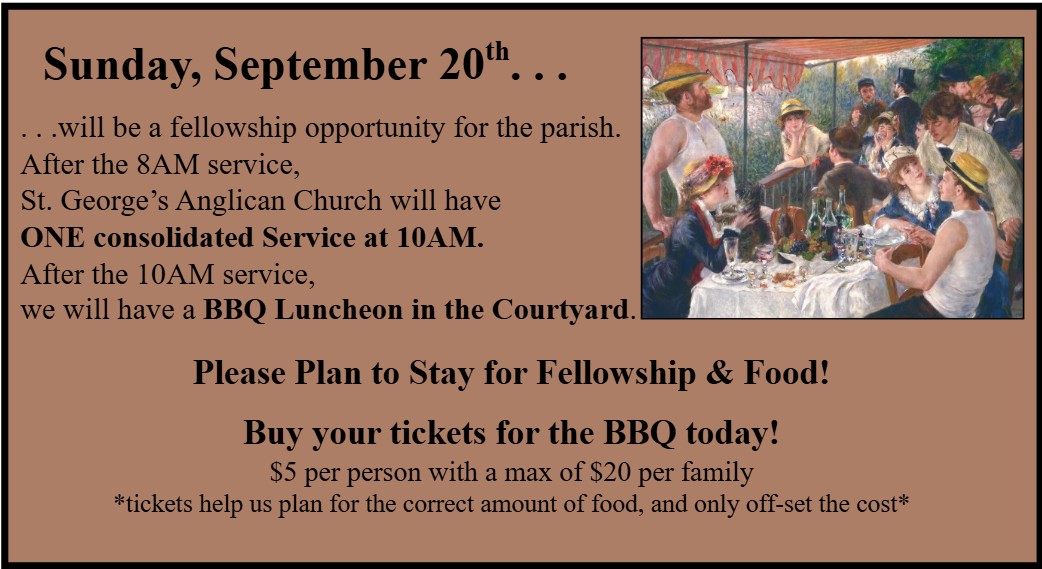

Annual Fall City Serve, October 3rd
Please join St. George’s Anglican Church as we partner with COS I Love You for their annual Fall City Serve day. This is a great opportunity to give your time and hard work to show Christ’s love through participating in a project.
Different projects include school clean up, yard work, or supporting our local heroes/first responders with gift bags and letter writing.
Please email stgacfamilies@gmail.com if you are interested in participating. We will share options and coordinate groups from STGAC.
Resource of the Week:
“If You Could Read My Mind: A Social Media Roundup About Men and Women” Article with video clips, by Anne Kennedy
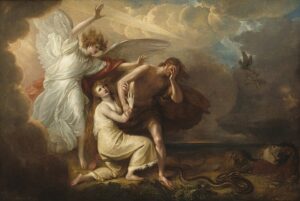 “But here’s the thing, the whole point of the attention of the husband is that you do not overtly ask for it. It’s supposed to be given without having to ask. Look, I don’t make the rules. This is just how it is. So the husband is a big failure here. No matter what her hair looks like, because she took the trouble to go have it done, he should be delighted. This is Rule Numero Uno in marriage. It’s because she’s making a bid for his attention and affection and he should accept the bid with generosity and affection.
But see, he didn’t, and the reason he didn’t is because there have been many long years of her not liking being told what to do. But see, she can’t be told what to do because ain’t nobody gonna tell any TikTok Lady what to do amirite. So these two have years of misery and rejection behind them. Hating her expensive hair that makes her feel fresh and happy is the perfect way to get her for all the disrespect, the argumentation, the picking at him that everything he does is wrong. And going on TikTok to complain about him is the perfect way to grind him down just a little bit more into the well manicured lawn because the HOA is so particular that you’ve had to pay someone to come do that too—along with the nails, the hair, the cleaning, and the person who shops for you when you click through the app.”
https://annekennedy.substack.com/p/if-you-could-read-my-mind
Andrew Kim Taegon (1821-1846)
 Thascius Caecilius Cyprianus (c. 200/210–14 September 258), was the principal Latin father of the third century and the first bishop-martyr of Africa.
Life
Born at Carthage of a wealthy pagan family, he received a first-rate rhetorical and legal education and practiced as an orator and teacher. Conversion came late, about 245–246, through the presbyter Caecilius, whose name he added at baptism. He sold estates for the poor, embraced a disciplined life, and within two or three years was ordained deacon, then priest. In 248 or 249 the people elected him bishop of Carthage over clerical opposition—an unusually rapid elevation for a neophyte.
Ministry
His episcopate of roughly a decade was spent under two imperial persecutions and a severe plague.
- Decian persecution (250–251). He withdrew from the city—not from cowardice, but to govern by letter and preserve the flock from having no shepherd. The lapsi (those who sacrificed or obtained certificates of sacrifice) produced a pastoral crisis. Cyprian took the via media: serious public penance before reconciliation, against both the laxist party around Felicissimus and the rigorist Novatianists who denied restoration altogether. The treatises De lapsis and De unitate ecclesiae catholicae (251) belong to this period. The latter contains the famous sentence: “He can no longer have God for his Father who has not the Church for his mother.”
- Plague. The epidemic later named after him (c. 249–262) struck Carthage hard. He organized care of the sick and wrote De mortalitate. The treatise is the principal literary source for the symptoms and social effect of the mid-third-century epidemic. Theologically it fixes, earlier and more sharply than most Latin writers, the Christian reading of death as transit to Christ, of common disease as unequal destiny, and of public catastrophe as both judgment and recruitment. Augustine later preached on Cyprian’s feast; later Western pastoral theology of plague and bereavement repeatedly returned to this short work.
- Baptismal controversy. Three African councils (255–256), the last attended by 87 bishops, declared baptism administered outside the Catholic Church invalid and required rebaptism of those coming from heretical or schismatic groups. Pope Stephen I held the opposite view. Correspondence grew sharp; communion was not formally broken.
- Valerian persecution. Exiled to Curubis in 257, he was recalled, tried by the proconsul Galerius Maximus, and beheaded outside Carthage on 14 September 258 after refusing to sacrifice to the Roman Gods. He met the sentence with the words “Thanks be to God,” bound his own eyes, and gave the executioner a gift. Crowds of the faithful cried that they wished to die with him.
His extant corpus consists of some 80 letters and a dozen treatises (On the Lord’s Prayer, On Works and Alms, Testimonies against the Jews, etc.). The Latin is clear, forceful, and indebted to Tertullian.
Legacy
Cyprian supplied the West with its classic third-century doctrine of the visible, episcopal Church: one body, one episcopate in collegial unity, no salvation outside that communion. Augustine esteemed him highly; later Western theology of penance, baptism, and church order repeatedly returned to him. He is commemorated in East and West (Western feast 16 September; Anglican 26 September) and remains the type of the pastor who shepherds through plague, schism, and martyrdom without abandoning either discipline or charity.