


Annual Fall City Serve, October 3rd
Please join St. George’s Anglican Church as we partner with COS I Love You for their annual Fall City Serve day. This is a great opportunity to give your time and hard work to show Christ’s love through participating in a project.
Different projects include school clean up, yard work, or supporting our local heroes/first responders with gift bags and letter writing.
Please email stgacfamilies@gmail.com if you are interested in participating. We will share options and coordinate groups from STGAC.
Resource of the Week:
 “Smart Phones or Smart Kids: Pick One” at National Review
“Anytime people are asked to do analog versus digital when it comes to learning, 90 percent of the time they will do worse on the digital,” Horvath tells me. When we read from screens, we are less likely to maintain focus or grasp complex details. In physical books, words and paragraphs are placed in fixed locations on a page, and this spatial quality helps the brain comprehend and retain information. “Space is a huge aspect of our memories,” Horvath said. “When you read on a screen and you’re scrolling, there is no three-dimensional location. . . . An entire aspect of human memory just gets dumped.”
Such concerns about EdTech are supported by an abundance of research. One 2022 study, for instance, determined that “even small daily amounts of use of digital devices” in classrooms were negatively related to reading comprehension. A 2020 analysis of more than 900,000 fourth-graders, meanwhile, found that school computer use was negatively associated with test scores. Parents and researchers have been especially vocal about these issues, and the movement to limit EdTech is taking hold among teachers. “Almost every educator I have talked to has sounded the alarm about students’ social and emotional development, attention spans, all of these concerns,” says Meredith Coffey, a teacher turned senior policy associate at the Thomas B. Fordham Institute, an education-policy think tank.
https://www.nationalreview.com/magazine/2026/10/smart-phones-or-smart-kids-pick-one/
Cyprian of Carthage, Bishop and Martyr
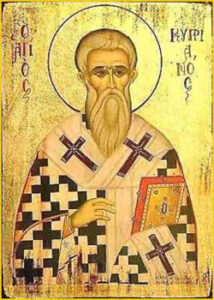 Thascius Caecilius Cyprianus (c. 200/210–14 September 258), was the principal Latin father of the third century and the first bishop-martyr of Africa.
Life
Born at Carthage of a wealthy pagan family, he received a first-rate rhetorical and legal education and practiced as an orator and teacher. Conversion came late, about 245–246, through the presbyter Caecilius, whose name he added at baptism. He sold estates for the poor, embraced a disciplined life, and within two or three years was ordained deacon, then priest. In 248 or 249 the people elected him bishop of Carthage over clerical opposition—an unusually rapid elevation for a neophyte.
Ministry
His episcopate of roughly a decade was spent under two imperial persecutions and a severe plague.
- Decian persecution (250–251). He withdrew from the city—not from cowardice, but to govern by letter and preserve the flock from having no shepherd. The lapsi (those who sacrificed or obtained certificates of sacrifice) produced a pastoral crisis. Cyprian took the via media: serious public penance before reconciliation, against both the laxist party around Felicissimus and the rigorist Novatianists who denied restoration altogether. The treatises De lapsis and De unitate ecclesiae catholicae (251) belong to this period. The latter contains the famous sentence: “He can no longer have God for his Father who has not the Church for his mother.”
- Plague. The epidemic later named after him (c. 249–262) struck Carthage hard. He organized care of the sick and wrote De mortalitate. The treatise is the principal literary source for the symptoms and social effect of the mid-third-century epidemic. Theologically it fixes, earlier and more sharply than most Latin writers, the Christian reading of death as transit to Christ, of common disease as unequal destiny, and of public catastrophe as both judgment and recruitment. Augustine later preached on Cyprian’s feast; later Western pastoral theology of plague and bereavement repeatedly returned to this short work.
- Baptismal controversy. Three African councils (255–256), the last attended by 87 bishops, declared baptism administered outside the Catholic Church invalid and required rebaptism of those coming from heretical or schismatic groups. Pope Stephen I held the opposite view. Correspondence grew sharp; communion was not formally broken.
- Valerian persecution. Exiled to Curubis in 257, he was recalled, tried by the proconsul Galerius Maximus, and beheaded outside Carthage on 14 September 258 after refusing to sacrifice to the Roman Gods. He met the sentence with the words “Thanks be to God,” bound his own eyes, and gave the executioner a gift. Crowds of the faithful cried that they wished to die with him.
His extant corpus consists of some 80 letters and a dozen treatises (On the Lord’s Prayer, On Works and Alms, Testimonies against the Jews, etc.). The Latin is clear, forceful, and indebted to Tertullian.
Legacy
Cyprian supplied the West with its classic third-century doctrine of the visible, episcopal Church: one body, one episcopate in collegial unity, no salvation outside that communion. Augustine esteemed him highly; later Western theology of penance, baptism, and church order repeatedly returned to him. He is commemorated in East and West (Western feast 16 September; Anglican 26 September) and remains the type of the pastor who shepherds through plague, schism, and martyrdom without abandoning either discipline or charity.