

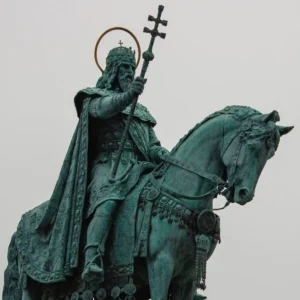
King Stephen I of Hungary (Hungarian: Szent István király; c. 975 – 15 August 1038), born Vajk, was the last Grand Prince of the Hungarians (997–1000/1001) and the first King of Hungary (1000/1001–1038). He is regarded as the founder of the Hungarian Christian state and one of the most consequential figures in Hungarian history.
Life Born in Esztergom to Grand Prince Géza of the Árpád dynasty and his wife Sarolt, Stephen was baptized as a youth and raised a Christian, becoming the first devout Christian ruler of his line. In 996 he married Gisela of Bavaria, sister of the future Holy Roman Emperor Henry II, thereby linking the Hungarian dynasty to the Ottonian house. Upon Géza’s death in 997, Stephen secured the succession by defeating his pagan cousin Koppány, who claimed the throne under traditional seniority rules. He was crowned king on 25 December 1000 or 1 January 1001 with a crown sent by Pope Sylvester II, marking Hungary’s formal entry into the community of Christian European kingdoms.
Accomplishments Stephen unified the Carpathian Basin through campaigns against semi-independent tribal leaders, including the Black Hungarians and his uncle Gyula the Younger. He organized the kingdom on Western (primarily German) administrative models, established a standing army, promoted agriculture, and enacted laws protecting private property.
Ecclesiastically, he founded at least one archbishopric, six bishoprics, and several Benedictine monasteries, including the important abbey at Pannonhalma (Martinsberg). He mandated church construction, introduced tithing, dispatched missionaries, and suppressed pagan practices, thereby creating an independent Hungarian ecclesiastical hierarchy free from direct imperial control. His reign was largely peaceful after the initial consolidations, with the notable exception of an invasion by Emperor Conrad II in 1030, which he successfully repelled.
Legacy Stephen’s primary achievement was the transformation of the Magyar tribal confederation into a stable Christian kingdom capable of enduring in the Carpathian Basin—unlike the Huns and Avars who had preceded them. He is venerated as a saint (canonized in 1083, together with his son Emeric). His feast is observed on 16 August in the Roman calendar and on 20 August in Hungary, where it is celebrated as a national holiday commemorating the foundation of the state. The Holy Crown of Hungary, traditionally associated with his coronation, remains a central symbol of Hungarian sovereignty. On his deathbed he is said to have dedicated the kingdom to the Blessed Virgin Mary.
Stephen is remembered as both a capable military and political consolidator and a zealous Christian ruler who anchored Hungary firmly within Western Christendom.